

How To Set Up A Pa System For Dj
The functioning of whatsoever loudspeaker volition be influenced past the acoustics of the space in which they operate. Difficult room acoustics, combined with improper loudspeaker placement, tin can interfere with achieving the fidelity of which your loudspeakers are capable. Understanding how a room interacts with audio will help you to get the virtually out of your system.
Recognizing Problem Rooms
In most live environments, the room is rarely designed to maximize the listening feel. For large-calibration tour productions, venues are often sports arenas that have been designed to maximize crowd noise. Smaller music venues are often chosen for location or architectural aesthetics, rather than music reproduction. It'south necessary to recognize and correct what that space does to the sound system in lodge to optimize the P.A.'s performance in the venue.
In general, the following concrete features of a room can bear on a sound arrangement'due south performance:
Size. The size of the room directly impacts how well certain frequencies will be reproduced. This may seem odd until you think about the physical length of audio waves at various frequencies. When a room'south width or length correlates directly to the length of a waveform at a specific frequency, a standing wave tin occur where the initial sound and the reflected sound begin to reinforce each other.
 Permit's say nosotros take a long, narrow room where the distance from one side to the other is 22.6 anxiety. A 50 Hz wave is also about 22.six feet long. (To calculate how long an audio wave is, dissever the speed of sound—i,130 ft./second—by the frequency. For a 50 Hz wave, 1,130/50 = 22.6 ft.) When a fifty Hz moving ridge bounces off the wall, the cogitating wave travels right back forth the same path and bounces off the other wall, and the cycle repeats. In a room such as this, 50 Hz reproduces very well—maybe too well. So any audio in that room will have a heavy low end because the low frequencies are existence exaggerated by the room acoustics and you lot're likely to have for compensate for them, either in your mix or by using a system EQ.
Construction. Low-frequency waves tin be powerful enough to cause the walls, ceiling, and fifty-fifty the floor, to flex and move. This is called "diaphragmatic action," and it dissipates energy and strips away the low-end definition. So if your room's walls and flooring are made of solid brick and physical that don't vibrate much, the bass response is going to be much more powerful than if you're in a room where the walls are normal sheet rock construction and the floors are hardwood.
 Reflectivity. Another way a room interacts with sound waves is through reflectivity. Like near room anomalies, reflections tin exist skilful and bad. Consider the outcome of a cathedral's reflections on a choir or a pianoforte. This type of reverberation (reverb) is quite desirable for recording and acoustic listening but not for loudspeakers reproducing audio at normal phase volumes. If a speaker is placed virtually a reflective surface (such as a brick wall or window), the directly sound coming from the speaker and the reflected sound coming from the wall can arrive at the listener'due south ears out of phase with each other, causing cancellation and/or reinforcement.
If yous are setting up your loudspeakers in a reverberant space, position your speakers so that as much sound as possible is focused on middle of the room and steered abroad from cogitating surfaces. Installing acoustic handling on the walls will too lessen the impact of reflections at your listening position.
Wall and Cor ner Loading
Very low frequencies are non directional, so they radiate from the sides and back of the loudspeaker, every bit well as from the forepart. If you place a loudspeaker confronting a wall, the rear sound propagates back into the room. This tin can increase the bass frequency output every bit much as 6 dB if the speaker is placed near one wall (half-space loading), 12 dB if placed near ii walls (quarter-space loading), and as much as 18 dB if you put the loudspeaker next to the ceiling or on the floor in a corner (eighth-infinite loading).

To have the about control over your audio, it'south all-time to start with the flattest response, then you normally should avoid wall and corner placement. On the other hand, if you need some extra bass boost, this technique may be worth a endeavour. It is important to be aware of what's happening and exist prepared to have advantage of it or compensate for it.
Because a floor monitor placed on the stage is unavoidably subject to one-half-space loading, PreSonus loudspeakers feature a "Monitor" preset. This preset is specifically designed to compensate for bass buildup while maintaining a tight mid-bass response and a clear midrange.
Area Coverage
The size and shape of your room and the application for which information technology will be used make up one's mind, to a large extent, how many speakers you will need and where they should be placed. In every situation, keep in mind your loudspeaker'southward coverage blueprint.
Horizontal Coverage. It is of import to place loudspeakers and then that there is a smooth transition from one loudspeaker'due south coverage area to the next loudspeaker'due south coverage area. This creates an even response throughout the listening space.

Vertical Coverage. If yous are using a footing stack with a pole mountain, make certain your vertical coverage matches the listening plane. Suspending speakers volition provide even farther control. PreSonus loudspeakers feature dual-position pole mounts. Using the downward tilt mount volition focus the loudspeaker'southward energy onto the audition and avert destructive reflections. This is ideal for situations where the loudspeaker is mounted atop a tripod stand and placed on a stage, or where the pole-mounted loudspeaker is on the flooring and the coverage expanse is relatively shallow (conference, java house, etc.).


A Quick Notation on Stage Monitoring: When used as a floor monitor, a loudspeaker's coverage pattern will reverse (that is, horizontal coverage becomes vertical coverage and vice versa). In most cases, this new design offers benefits. For example, when laid downwardly as a floor monitor, a PreSonus ULT12 has a 50˚ (H) ten 110˚ (Five) coverage design. As the dispersion narrows to l˚ in the horizontal, the floor monitor's energy is focused to a relatively limited area that won't drain over into either side, creating listening zones and improve clarity. The 110˚ dispersion in the vertical allows the performer the freedom to motility forrad and back within their zone. For case, a vocaliser can stand directly on top of their floor monitor to attain out to the audience and hear their mix besides as they can when they back upwardly to the front of the drum kit to bound off the bass drum. Some loudspeakers, such equally the PreSonus ULT-series, allow you lot to rotate the horn so that the dispersion pattern is the same in both vertical and horizontal orientations. In general, this characteristic should be reserved for horizontal mains utilize, not for floor monitoring.

Distributed Delay Systems
In near situations, a PA arrangement relies on a main speaker system, positioned at the front of the room, to reproduce audio for the entire functioning infinite. Every bit a result, the level of the system is considerably louder at the forepart of the room than it is at the mix position.
In situations where sound must be reproduced outside of the chief organisation's optimum range, well-placed delay systems tin extend the intelligibility of the forepart-of-house organisation. By creating listening zones throughout the room, your front-of-business firm organisation only needs to be loud enough to encompass the front of the room. As a effect, yous tin lower the mains level, requite the front end-row listeners' ears a suspension, and get better fidelity from your speakers.
 The goal of distributed sound is for the people in the back row have the same listening feel as the people in the front, but it isn't as easy as just putting up an extra pair of speakers. Since electricity travels much faster than sound, listeners in the rear of the room will hear the sound coming from the nearest set up of speakers earlier they hear the sound from stage. This dampens the assault and intelligibility of the sound, creating an unpleasant phasing effect. In large venues, this can actually audio like a short repeat.
To create a delay sound system, you lot need to delay the signal going to the additional speakers. For example, since audio travels at nigh 1,130 feet per second (with some variation due to temperature, humidity, and pinnacle), it takes most 45 ms for sound to travel 50 feet. And so if you put your delay speakers 50 feet away from the Front-of-House system, yous need to delay the signal going to the satellite system by 45 ms.
To calculate the filibuster, split the distance measured in anxiety by 1.13.
 One time y'all have positioned and delayed your satellite system, utilise an SPL meter to match the output of the main and delay systems at the measurement bespeak. For instance, if you are standing 30 anxiety from the left side of the main system and 10 feet from the left side of the delay arrangement, and the output of the main system is 85 dB, then the output of the delay system should also be 85 dB.
It should be noted that frequencies in the sub-bass range of a delay system do not require distribution. In fact, a delay system'southward highpass filter should exist rolled up every bit high equally 300 to 400 Hz to avoid audio going back toward the stage as low frequencies become omnidirectional.
In that location are standalone speaker processors that provide output delays to configure distributed delay systems. Too, some digital mixers, similar the PreSonus StudioLive serial, offer delay on some or all outputs for precisely this purpose.
Delay systems should exist placed where the chief arrangement'south intelligibility falls apart every bit it is overcome by ecology obstacles:
- Within. Indoors, you are trying to overcome the direct-to-reverberant reflections. Your goal is to find where the directly signal-to-reverberation ratio has reached about fifty/50. At this point, the reflections in the room are at an equal level to the direct sound of the P.A., and vocal intelligibility is lost.
- Outside. Outdoors, you are trying to maintain level every bit the noise floor of the crowd begins to exist at equal level to the P.A. in the intelligibility range. At this point, the main organisation needs more support in society to deliver the same perceived loudness equally yous get farther from the source.
Adding a Subwoofer (or Two)
Adding a subwoofer to your sound arrangement allows it to run more efficiently because the low-frequency content is reproduced by the subwoofer instead of the total-range organization. This section will guide you through the steps necessary to add a subwoofer so that you get the well-nigh out of your investment.
Most subwoofers, including those made by PreSonus, provide throughputs to connect satellite full-range systems. However, in a large venue, it's recommended that you run your subwoofers on an output separate from your main front end-of-house total-range loudspeakers. A post-fader aux mix output is ideally suited for this equally it provides contained level control over the subwoofer system and greater flexibility over the bass content in your mix, while still following the main mix mutes. Creating an aux mix for your subwoofer system is just like creating an aux mix for a floor monitor only instead of creating a mix for a musician, you lot will be creating a mix using instruments that provide sub-energy content. Another advantage of using an aux mix is that if, for example, yous want the kick drum to dial louder in the subwoofer, you tin raise its level in the subwoofer only. Information technology is as well recommended that you run your subwoofer system in mono, even if your full-range system is in stereo. For information on creating an aux-fed subwoofer mix, please review this article.
Setting the Crossover
When adding a subwoofer to your full-range system, you will also need a crossover. This external device provides a highpass filter for full-range loudspeakers to remove audio content below a specified frequency, besides as a lowpass filter for subwoofers that removes audio content above a specified frequency. Depending on the system, leaving a frequency content overlap betwixt 60 to 120 Hz in your full-range loudspeakers and subwoofer can introduce subversive cancellation and reinforcement. Using a crossover will eliminate this frequency overlap and help you to create a more than seamless transition with your subwoofer. Most external crossovers are fully variable, assuasive you to create a smooth transition from your subwoofer organization into your full-range system.
Many full-range loudspeakers, including PreSonus StudioLive AI-series and ULT-series loudspeakers, help to mitigate this result past including a 100 Hz highpass filter. Some subwoofers, like the PreSonus ULT18, AIR15s, and AIR18s, are equipped with a variable lowpass filter, allowing you to dial in the best crossover bespeak for your organization. In this way, you lot tin can set the upper cease of your subwoofer at the lowest frequency point that your full-range system tin can reliably reproduce. PreSonus AIR-series subwoofers make this even easier past providing lowpass filter presets optimized for each AIR-series full-range speaker. For instance, if you are using an AIR15s subwoofer with an AIR10 full-range speaker, enabling the AIR10 lowpass filter preset will correctly set the AIR15s lowpass filter for use with the AIR10.
To set the crossover transition between your subwoofers and your full-range system:
- Set the subwoofer'south lowpass filter to its highest cutoff frequency. This will create an overlap between your subwoofers and your full-range system'due south frequency response.
- Play program music with a lot of bass through your full system.
- Experiment with the polarity setting on your subwoofer to meet which position provides the best bass response. Exit the polarity in the position that provided the loudest bass response. This means that your subwoofer is in phase with your total-range speaker.
- From this indicate, y'all can experiment with the lowpass and highpass filter settings until y'all find the 1 that provides the smoothest crossover transition. Once more, your subwoofer should naturally extend the low-frequency response of your full-range organisation. You should non hear any frequency boosts or cuts.
Once your crossover network is properly calibrated, listen to a wide diverseness of your favorite music and make whatever terminal adjustments. At the end of the day, your ears are the best tools you accept.
Sub Alignment
When your subwoofer and your full-range loudspeaker are placed some distance apart, low-frequency cancellation or reinforcement can occur when the same frequencies are reproduced past both systems. Using an alignment filibuster on your subwoofer system will compensate for this. To set up the right delay for a custom installation, you volition need to do some computing:
- Discover the spot in the room where coverage from the main speakers and the subwoofers overlap.

- Measure the distance in anxiety from the overlap area to each speaker location.
- Decrease the smaller altitude (the distance to the subwoofer) from the larger distance (the altitude to the total-range loudspeaker).
- Separate that number by i.13 and apply that filibuster value to the subwoofer. Keep in mind that the overlap area may be backside forepart-of-house.
Even for mobile applications, where the subwoofer is relatively shut to the full-range loudspeakers, aligning the subwoofer to its full-range companion will yield tighter bass response. Both PreSonus AIR-series and CDL18s subwoofers characteristic a variable alignment delay to guarantee that your three- and four-way systems stay in alignment.
Sub-pole Mounted. When your full-range speaker is mounted directly atop your subwoofer, no filibuster is necessary.
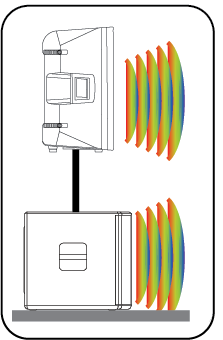
Tripod Mounted. When the subwoofer is almost three feet from the full-range loudspeaker—a typical distance when the loudspeaker is on an side by side tripod stand— delay your subwoofer past 2.7 ms.

Full-range Onstage. When the full-range loudspeaker is on stage and the subwoofer is on the floor, the typical distance is around six anxiety. Filibuster your subwoofer by five.iii ms.

Subwoofer Arrays
 Most subwoofers are essentially omnidirectional. This means that they radiate sound around the unabridged cabinet, including on the stage. In add-on to causing feedback onstage, subwoofer free energy can brand monitoring more than difficult because it overwhelms the frequency content performers need to hear. When 2 subwoofers are arranged on each side of the stage, at that place can be a build-upward of energy, resulting in a "power alley," equally free energy from each subwoofer arrives at the same time and in phase with ane some other, summing together. Unfortunately, moving left or right of this center summation, ane will find cancellation alleys.
Creating a cardioid subwoofer array forms a more directional radiation pattern that keeps energy off of the stage and in the audience, where it is needed.
 Ground-stacked Cardioid Array. For smaller spaces, creating a ground-stacked cardioid assortment is an easy way to focus the subwoofer onto the audience. This blazon of array is created past stacking two subwoofers, one on top of the other, with the top subwoofer facing abroad from the audience and toward the phase.
Yous volition need to polarity-invert the cabinet that faces away from the audience and filibuster it past the depth of the subwoofer. The AIR15s, and AIR18s subwoofers brand this easy by providing presets to create a ground-stacked cardioid assortment.
Once configured, your two subwoofers will radiate in a directional cardioid pattern, allowing you greater steering command over depression-frequency energy.
 Endfire Cardioid Array. An end-fire array is created when subwoofers are placed in a row so that they are driving sound along the same centrality. This focuses the sound in the direction the front end speaker is facing. End-fire cardioid subwoofer arrays provide approximately 20 dB more cancellation backside the array than a ground-stacked array, so they will direct the most subwoofer free energy away from stage.
Cease-fire arrays can be very tricky to create, because each subwoofer requires its ain delay simply must utilise the aforementioned polarity equally the other subwoofers in the array. Both the AIR15s and AIR18s make this quick and piece of cake past providing a preset. The CDL18s provides all the tools necessary to create an end-fire array with two or more subwoofers.
If you delay your subwoofer array relative to your full-range systems, be sure to set the same relative delay time on every subwoofer in the array.
Arrangement Configuration Suggestions
This section describes some common organisation configurations. The size and shape of your room too every bit your awarding volition make up one's mind how many speakers you volition need and where they should be placed. In any front-of-house situation, it'due south of import to ensure that the horn of your full-range loudspeaker is placed and then that it is in a higher place the heads of your audience. In large venues, this will crave suspending your loudspeakers from the ceiling or trussing.
Please note: Suspending loudspeakers should just be washed past a licensed and insured professional who tin ensure that all safe precautions and building codes are followed.
Stereo System. A stereo system allows panning and adds depth to the acoustic image. Because of this, it greatly enhances live or pre-recorded music. Locate speakers to give the all-time horizontal coverage. This will ensure that the listeners are well covered by the pattern.

Mono Cluster with Down Fill. Center or mono systems can provide a uncomplicated, economical solution for venues where speech intelligibility is the priority, rather than music. Equally with a stereo system, make sure the coverage pattern of the speaker focuses the free energy on the audience.
The graphic below, shows two speakers. The upper speaker is throwing to the dorsum of the room, and the lower speaker covers the space in the front of the room, closest to the stage.

LCR Systems. An LCR system is a stereo organisation with a center speaker added. This configuration allows panning and adds depth to the acoustic image. This blazon of organization will provide more control than a basic stereo system and is platonic in situations where music and speech intelligibility are every bit of import.

Distributed Delay System. The goal in a complicated system with loudspeakers distributed throughout the venue is to delay each satellite system relative to its analogue in the main system (eastward.g., the left front fill to the left FOH loudspeaker).

- Delay the main system relative to the source on stage. On small stages where the guitar amp and drum kit tin be conspicuously heard higher up the FOH loudspeaker system, delaying the main system can "move up" the backline and then that it aligns with these instruments and decreases blurring in the mix. This will tighten the overall mix and requite it more punch.
- Delay the front fills relative to the primary organization by delaying each side of the organisation independently (due east.g., filibuster the left front end fill relative to the left FOH loudspeaker).
- Delay subwoofers relative to the main organization. How yous do this will depend on how your subwoofer organisation is positioned and configured. In full general, yous will want to delay each subwoofer relative to the full-range loudspeaker closest to it.
- Filibuster down-fill speakers (upper and nether balustrade) relative to the main organisation, once again delaying each side of the system independently.
Stage Monitor Systems
Beneath are two examples of typical stage-monitor layouts. For musicians (such equally a vocaliser) who don't require a lot of depression-frequency energy in their floor wedge, we advise using a ten" or 12" loudspeaker. On larger stages, stereo monitors will provide improve clarity at a lower volume. For musicians that need a little more bass, a 15" loudspeaker may be preferable. For the drum monitor on a large phase, it is useful to employ a full-range, iii-style system (xv" loudspeaker atop a subwoofer). For smaller stages, a 15" loudspeaker atop a low tripod or in the horizontal flooring-wedge position volition be more than than adequate.
 _____________
Calibrating Full-Range Systems
After you have positioned your loudspeakers, it is helpful to set all the levels in the P.A. arrangement so that every component is optimized. While non essential, taking the time to properly calibrate your speakers will give you a groovy starting betoken to both troubleshoot and fine-tune your listening environment.
Speaker calibration ensures that a specific metered bespeak level on your mixer equals a predetermined SPL at front-of-firm. Depending upon the method and reference levels used during calibration, proper calibration can help reduce unwanted noise, minimize the risk of damage to loudspeakers and to your ears, and ensure you hear the audio equally accurately as possible.
There are many methods for calibrating a loudspeaker system. The important thing is not the way you lot calibrate your environment but that your surroundings has been calibrated—even if yous simply utilise your ears, mutual sense, and your favorite recording.
You should calibrate the right and left loudspeakers independently to ensure that both are set to the same acoustic level. This volition ensure that your speakers are balanced and that the audience will have the same listening feel wherever they are in the venue.
Calibrating Using a "Standard" Reference
Standard reference scale is ane of the about mutual scale methods because it is the least subjective. The goal of this method is to ensure that when the output meters on the mixer annals 0 dB, the SPL in the audience is a specified decibel level.
This level volition vary depending on your application:
- Acoustic (folk, spoken word, etc.): 75 to 90 dB
- Jazz: 80 to 95 dB
- Classical: 100 dB
- Modern house of worship: xc to 95 dB
- Electric (stone, land, R&B): 95 to 110 dB
This section will accept you lot through the basics of standard-reference calibration. Calibrating speakers requires both an SPL meter and pink racket. Both bespeak noise generator and SPL meter apps are available for iOS® and Android™, many for free.
- Connect the principal outputs of your mixer to your loudspeakers.
- Ready the level on your loudspeakers to their lowest setting.
- Ready the main mix level on your mixer to the lowest setting.
Notation: If y'all have any outboard processors (EQs, limiter, etc.) connected between the mixer and your loudspeakers, disconnect or bypass them. If your mixer has onboard processing, make sure that it is zeroed out or bypassed.
- Play xx Hz to 20 kHz full-bandwidth pink dissonance at 0 dB through the chief outputs of your mixer.
- Turn upwards the main mix to unity proceeds. Unity gain is the setting at which the indicate level is neither additional nor attenuated. It is usually marked by a "0" or a "U" on the mixer. Y'all should non hear the pink racket. If you do, repeat step ii.
- Brainstorm slowly increasing the book of your left speaker until the acoustic level of the pink noise reaches 3 dB below your desired SPL in the centre of the room. When both speakers play simultaneously, the overall SPL will increment by about
- +3 dB.
- Power down your left speaker.
- Slowly increment the volume of your right speaker until the sound pressure level of the test tone playing reaches the same SPL as the level assault your left speaker.
- Stop the pinkish noise and turn your left speaker back on. Play some program music you are familiar with through your speakers and move throughout the room, making sure that your speakers sound balanced.
If you are using a subwoofer, follow the same steps every bit above, merely set up the level on the subwoofer 6 dB less than the level you set on your full-range loudspeakers (that is, if yous set the level on each loudspeaker to 95 dB, set the subwoofer level to 89 dB).
Ringing Out Monitors
Feedback is short term for a feedback loop, where a portion of the signal from the speaker returns to the microphone, resulting in a constant tone at the offending frequency. "Ringing out" is a procedure of attenuating the frequencies that are feeding back to maximize gain before feedback in your floor monitors.
Note: Ringing out stage monitors will produce feedback. If you are not careful, you can produce a lot of feedback. Do not make sudden gain boosts; go slowly and carefully to avoid causing impairment to speakers and ears.
- With the mic input proceeds at an advisable level, bring the aux send level up on the mic aqueduct you lot wish to band. Do not "gain upward" the mic point on the monitor mixer for the sake of getting more than volume out of a stage monitor. Gain staging is very important in club to accept a feedback-gratis show.
- Slowly bring the aux output level up until you hear feedback.
- Using a existent-time analyzer (RTA) or spectrograph will allow you to encounter which frequency is causing the problem and use an blaster to remove the offender from your stage monitor. If you don't have an RTA or spectrograph, you can create a narrow notch in a parametric EQ and sweep information technology across the band until the feedback is removed. Stage-monitor feedback typically occurs in the college frequencies, which also is where intelligibility comes from, so only reduce the offending frequency to just below the point of feedback.
If you exercise non have these tools at your disposal, bring back the level on the channel send to merely before the point of feedback so you don't take out also much betoken content. Maximizing your intelligibility and gain structure results in clearer-sounding monitors.
When you are ringing out a system, and more than two or 3 feedback loops are happening simultaneously, you take reached the level where stability can no longer exist accomplished. Endeavour bringing downward the overall output level or observe a physical solution, such as moving the speaker or microphone.
Source: https://www.presonus.com/learn/technical-articles/configure-your-pa
0 Response to "How To Set Up A Pa System For Dj"
Post a Comment